Deep squat hold: daily sit time & progression
Getting a flat-heel deep squat sit takes 3 to 8 weeks of 5-minute daily practice, while holding it 2 to 5 minutes a day maintains hip and ankle mobility.
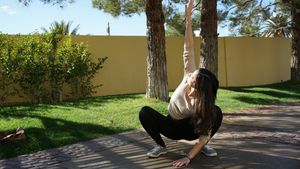
How long you need in a deep squat hold (or resting deep squat sit) depends on whether you are working to get your heels flat on the floor for the first time or maintaining your joint mobility:
- To unlock a flat-heel deep squat sit (3 to 8 weeks): If your heels lift off the floor or you tip backward right now, practicing 5 to 10 minutes a day (broken into 30- to 60-second supported holds with your heels elevated) gets most stiff adults flat on the floor in 3 to 8 weeks, or 2 to 4 months if both your ankles and hip capsules are tight.
- To maintain hip and ankle mobility (2 to 5 minutes a day): Once you can rest comfortably at the bottom, sitting in a deep squat for 2 to 5 cumulative minutes a day keeps your ankles, knees, and lower back decompressed, while intensive restoration protocols like Ido Portal's 30/30 Squat Challenge accumulate 15 to 30 minutes a day for 30 days to reverse years of chair sitting.
Unlike a gym exercise squat where you stop at parallel to keep muscular tension on your quads and glutes, a resting deep squat (also called a primal squat or Asian squat) is a floor-sitting posture where your hamstrings rest completely against your calves. In a 2020 study in PNAS, evolutionary anthropologists David Raichlen and Herman Pontzer tracked Hadza hunter-gatherers in Tanzania and found that adults rested an average of 9.9 hours a day—nearly identical to modern office workers—but spent much of that rest in active floor postures like squatting and kneeling, which keep the lower-limb muscles and joints engaged rather than switched off in a chair.
How long to hold a deep squat each day (by goal)
Your daily hold target changes depending on whether you are building initial tolerance, checking your baseline mobility, maintaining healthy joints, or running a 30-day restoration block:
| Goal | Single hold | Daily total | Setup & focus |
|---|---|---|---|
| 1. Stiff beginner | 30–60 sec | 2–3 min / day | Heels elevated or supported |
| 2. Baseline check | 2 min straight | 2–3 min / day | Heels flat, unassisted |
| 3. Daily maintenance | 1–2 min sets | 5 min / day | Relaxed spine & hips |
| 4. 30/30 restoration | 2–5 min sets | 15–30 min / day | Micro-breaks all day |
Sitting comfortably at the bottom of a flat-heel squat demands far more joint flexion than sitting in a 90-degree chair. When biomechanics researchers at Queen's University (Hemmerich et al., 2006) measured three-dimensional joint angles in adults performing floor postures, they found that a full resting squat requires an average of 157 degrees of knee flexion, 95 degrees of hip flexion, and 38.5 degrees of ankle dorsiflexion (your shin angling forward over your foot).
As GMB Fitness explains in its bodyweight deep squat guide, holding a squat halfway down with your thighs parallel to the floor is an exhausting leg-strength drill, whereas sinking all the way down lets your skeletal structure and connective tissue share the load. Once your hamstrings rest on your calves, your knee and hip capsules experience gentle, sustained decompression while synovial fluid lubricates the joint cartilage.
How long does it take to get a flat-heel deep squat sit?
Most adults who elevate their heels and practice 5 to 15 minutes a day can reach an unassisted flat-heel deep squat sit in 3 to 8 weeks, while deeper hip and ankle restrictions take 2 to 6 months:
| Starting restriction | Daily practice | Typical timeline | Primary bottleneck |
|---|---|---|---|
| Mild calf tightness | 5 min / day | 2–4 weeks | Soleus & Achilles |
| Heels lift 1–2 inches | 10 min / day | 4–8 weeks | Flexed-knee ankle ROM |
| Tight ankles & hips | 15–20 min / day | 2–4 months | Ankles & hip adductors |
| Deep joint block | 15–30 min / day | 4–6+ months | Talus glide or hip socket |
When your heels pop off the floor or you fall backward the moment you drop below parallel, the bottleneck is almost always restricted ankle dorsiflexion rather than weak leg muscles. In a 2015 biomechanics study of 101 adults published in the Journal of Human Kinetics, researchers found that squat depth is governed primarily by flexed-knee ankle dorsiflexion, hip flexion range of motion, and tibialis anterior strength (the muscle on the front of your shin). To keep your center of mass balanced over the middle of your feet at the bottom of a squat, your knees must travel several inches forward past your toes. If a tight soleus muscle or stiff ankle capsule blocks your shins from angling forward, your hips stay stranded behind your heels and gravity pulls you backward unless you rise onto your tiptoes.
Physical therapist Dr. Aaron Horschig of Squat University uses the 5-inch knee-to-wall test (the clinical weight-bearing lunge test) to check whether your ankles or hips are dictating your timeline:
- Set up 5 inches from a wall: Kneel on one knee facing a wall and place the big toe of your front foot 5 inches (12.5 cm) away from the baseboard.
- Drive your knee forward: Keeping your front heel glued to the floor, push your knee forward directly over your second toe toward the wall.
- Read the result:
- Your knee touches the wall with your heel flat: Your ankle already has the ~38 degrees of dorsiflexion needed for a deep squat. If you still cannot sit into a deep squat, your restriction is in your hip capsules or inner thighs (adductors).
- Your heel lifts and you feel a stretch in your lower calf: Your soleus muscle and Achilles tendon are tight (typically a 3- to 8-week fix with daily heel-elevated squats and calf work).
- You feel a sharp block or pinch in the front of your ankle: The talus bone is not gliding backward smoothly inside the ankle joint, which responds best to banded joint mobilizations rather than passive calf stretching.
3-step deep squat progression if your heels lift
If you cannot hold a flat-heel squat yet, forcing yourself to balance on your tiptoes only overloads your knees and keeps your hips braced. Instead, adjust the geometry so your heels have a surface to press into right away, then pair your holds with active ankle and hip drills.
1. Elevate your heels on a wedge or rolled mat
In both GMB Fitness's squat progression and Daniel Vadnal's FitnessFAQs squat mobility workout, the first adjustment for stiff ankles is sliding a rolled-up yoga mat, a paperback book, or a pair of small weight plates under your heels. Elevating your heels by 1 to 2 inches gives you the forward shin angle your ankles currently lack, letting your torso stay upright and your hamstrings sink all the way onto your calves. As the position gets comfortable over several weeks, switch to a thinner book or fold the mat one fewer time until your heels touch the floor.
2. Hold a doorframe or light counterweight
If you still feel like you are tipping backward, drop into your squat in front of a sturdy doorframe, banister, or heavy table leg and hold on with both hands. Leaning gently against an anchor lets you sit at full depth with flat heels and relax your hip flexors. Once you feel stable, switch to holding a 5- to 10-pound weight (or a loaded backpack) out in front of your chest, then practice slowly pulling your torso forward using the muscles on the front of your shins until you can let go of the counterweight.
3. Open the soleus and hips before your hold
In his 15-minute follow-along squat mobility routine and beginner squat flexibility guide, calisthenics coach Tom Merrick (Bodyweight Warrior) places active joint work between a 60-second baseline squat hold and a 60-second retest hold:
- Half-kneeling ankle rocks (2 minutes): From a half-kneeling lunge, rest your chest or a kettlebell on your front thigh and pulse your knee forward over your toes for 10 to 15 slow reps per side, pausing for 5 seconds at the end range with your heel down.
- 90/90 hip rotations (2 minutes): Sit on the floor with both knees bent at 90-degree angles and rotate your legs from side to side to open internal and external hip rotation, giving your thigh bone room to sink into the hip socket without pinching.
- Elbows-to-knees squat prying (1 minute): Sit into your deep squat, place your elbows inside your knees with your palms together, and gently press your knees outward while shifting your weight from your left foot to your right foot.
How to track your daily deep squat holds
You can use timespent to accumulate deep squat hold minutes across the day and keep your favorite squat mobility videos right next to your timer.
Create a Timed Activity for your deep squat holds and set a daily Do More goal—such as 5 minutes for daily joint maintenance, 10 minutes to unlock flat heels, or 30 minutes if you are running a 30/30 squat challenge. Because the timer counts up on your Lock Screen and Dynamic Island, you can drop into a 90-second squat sit while waiting for coffee to brew or taking an afternoon desk break, and every short hold adds up automatically toward your daily bar. You can also place a Link widget on your Activity page to pin a follow-along routine like Tom Merrick's 15-minute squat mobility session, so the video plays right inside the app next to your calendar heat map and weekly totals.


Common questions
How much hold time do you accumulate at 2 to 30 minutes a day?
Breaking your deep squat practice into short 60- to 90-second holds across the day adds up quickly over a 30-day block without straining your knees:
| Daily target | Sets per day | 30-day total | Best for |
|---|---|---|---|
| 2 min / day | Two 60s holds | 1 hour / mo | Baseline maintenance |
| 5 min / day | Five 60s holds | 2.5 hours / mo | Daily joint decompression |
| 10 min / day | Ten 60s holds | 5 hours / mo | Unlocking flat heels |
| 30 min / day | Ten 3-min holds | 15 hours / mo | 30/30 Squat Challenge |
At 10 minutes a day, 10 minutes × 30 days = 300 minutes (5 hours) of low-load tension per month. Because tendons and joint capsules remodel over weeks of recovery rather than pure stopwatch hours, five to ten short holds spread across every day will get your heels flat much faster than a single long stretching session once a week.
What are the benefits of holding a deep squat every day?
Spending 2 to 5 minutes a day in a resting squat counteracts the three main mechanical effects of chair sitting: it restores flexed-knee ankle dorsiflexion (which protects your knees when walking downstairs or running), decompresses the lower back by gently lengthening the lumbar paraspinals and glutes, and flushes synovial fluid through the full 157-degree flexion arc of the knee cartilage.
Is the Ido Portal 30/30 squat challenge safe for beginners?
The 30/30 Squat Challenge—accumulating 30 minutes a day in a resting squat for 30 consecutive days—is safe for healthy adults only if you break the time into short 1- to 3-minute sets and use heel support whenever your heels lift. Jumping straight from zero floor sitting to 30 minutes of unsupported squatting per day often irritates the front of the ankles or inner knees. If you are a stiff beginner, start with a 5- to 10-minute daily target for the first two weeks, use a heel wedge or doorframe anchor so your joints never pinch, and scale up by 5 minutes per week.
Should your back stay straight or rounded in a resting squat?
In an unweighted resting squat on the floor, a softly rounded lower and mid-back is completely normal and safe. A rigid, arched spine is necessary when you have a heavy barbell across your shoulders, because compressive load on a rounded lumbar spine stresses the intervertebral discs. When you are simply resting your body weight at the bottom of a deep squat sit, letting your pelvis tuck slightly and your spine relax allows your back muscles to lengthen and rest.