Music practice log: what to track and how
A music practice log tracks 6 things per session: date, warm-up, bars worked on, start and end BPM, minutes played, and your next session's focus.
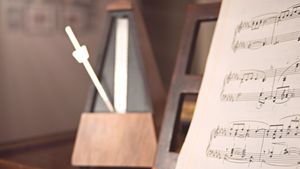
A good music practice log records six details in under a minute: the date, your warm-up or technical drill, the specific bars of your piece, your starting and ending metronome tempo (BPM), minutes practiced, and one line on where to start tomorrow. Writing down which bars tripped you up and the tempo you reached turns aimless playing into a clear plan for your next session.
Berklee Online voice professor Patrice Williamson notes that without a written plan and practice journal, it's easy to spend your whole session playing what already sounds good. In a 2009 study of 17 piano majors learning a tricky three-measure Shostakovich passage, Robert Duke and his colleagues at the University of Texas at Austin found that how many minutes a student practiced had no significant link to how well they played the passage the next day. What separated the top players was how they handled mistakes: they pinpointed the exact spot where a measure fell apart, slowed it down, and repeated it until the majority of their attempts were clean.
What should you put in a music practice log?
Track six things for each session: the date, your warm-up or technical drill, the piece and bar numbers you isolated, your start and end BPM, your minutes played, and your focus for the next session. Limiting each entry to those six items lets you log your session in 60 seconds while your instrument is still in your hands:
- Date: Logging each day you sit down to play shows how consistently you show up across the week. Muscle memory and finger conditioning depend on how many days a week your hands touch the instrument, and seeing gaps catches a skipped day before it turns into a skipped week.
- Warm-up and technique: Note the scales, arpeggios, chord changes, or ear training drills you used to warm up your hands and ears. Educators at Musical U recommend logging ear training here too, such as singing along to scales or figuring out a short melody by ear, so you don't skip listening drills to jump straight into songs.
- Piece and bar numbers: Write down the title of the piece and the 1- to 4-bar section you worked on. Logging "bars 12 to 15" stops you from starting at bar 1 every day and spending your freshest attention on the intro you can already play in your sleep.
- Start and end tempo (BPM): Record the fastest metronome speed where you could play the passage cleanly at the start of the session, and the speed you reached by the end. Watching a tough passage climb from 60 BPM on Monday to 84 BPM on Friday proves your finger coordination is improving even when the piece isn't at performance tempo yet.
- Minutes practiced: Track how long you actually played. Musical U suggests comparing the time you planned to spend on each part of your session with the minutes you actually logged, which quickly shows if you're rushing through scales to get to your favorite piece.
- Next-session focus: Leave a one-line instruction for tomorrow, such as "Start at bar 16, left hand alone at 68 BPM." When you sit down the next day, you can go straight to the bar that needs work instead of noodling for five minutes to remember where you left off.
What does a good music practice log look like?
Each entry is a single row of shorthand notes rather than a long diary entry. Here is how a piano student and a guitar student log four 25- to 30-minute sessions across a week:
| Date | Warm-up / technique | Piece & bars worked on | Tempo (start → end BPM) | Minutes | Next-session focus |
|---|---|---|---|---|---|
| Mon (Piano) | G major scale, 2 octaves, hands separate | Bach Minuet in G, bars 9–12 (left hand + hands together) | 64 → 76 BPM | 25 min | Bars 13–16 hands separate; keep right wrist loose on the thumb-under |
| Tue (Piano) | G major scale, hands together; sang intervals | Bach Minuet in G, bars 13–16; full run of bars 1–16 | 68 → 80 BPM | 30 min | Connect bars 8–9 transition without pausing; start at 72 BPM |
| Wed (Guitar) | Chromatic 1-2-3-4 spider drill; C ↔ G 1-min changes (22 clean) | "Wish You Were Here" intro riff + verse strumming, bars 1–8 | 60 → 70 BPM | 25 min | C ↔ G 1-min changes (aim for 25); arch ring finger on G chord |
| Thu (Guitar) | Spider drill on frets 1–4; Am ↔ Dm 1-min changes (26 clean) | "Wish You Were Here" intro transition into first chord, bars 7–10 | 66 → 74 BPM | 30 min | Play bars 1–10 straight through 5× clean at 72 BPM |
In The Musician's Way, guitarist and educator Gerald Klickstein also recommends grouping what you practice into five areas so your week stays balanced: new pieces, developing pieces, performance pieces, technique (such as scales and arpeggios), and musicianship (such as sight-reading and ear training). Checking your log at the end of the week shows immediately if all your time went to one song while technique or ear training got skipped.
Why does keeping a practice log help you improve faster?
Writing down what you practiced and reflecting for one minute at the end of a session trains your brain to spot mistakes early and stay with hard passages longer. Juilliard performance psychologist Noa Kageyama points out that tracking your own progress turns you into your own coach between lessons.
Kageyama highlights a study by educational psychologist Dale Schunk in which children spent 30 minutes a day practicing math problems across three sessions. Every group completed about the same amount of work each day, but the students who wrote down their own progress at the end of each session scored more than twice as high on the final test as the students who didn't log their work (13.3 vs. 5.8 out of 18). They also stuck with tough problems nearly twice as long before giving up (30.6 seconds vs. 18.6 seconds).
Taking 60 seconds after you stop playing to note what broke down and what to try tomorrow is just as important as logging the time itself. In a Dutch study of 222 junior competitors reviewed by Kageyama, pausing to reflect after practice was the one habit that separated international-level performers from national-level peers. When you write "bar 6 went out of tune on the shift, slow down and check finger spacing tomorrow," your brain links the physical feel of the mistake to a concrete fix while the motor memory is still fresh.
What should you log for piano vs. guitar practice?
Both a piano practice log and a guitar practice tracker record minutes, bars, and BPM, plus two or three shorthand notes for the physical hurdles of your instrument:
- For a piano practice log: Piano teacher Melanie Spanswick recommends recording each 20- to 30-minute piano practice routine right after you finish playing. Mark whether you practiced a section right hand alone (
RH), left hand alone (LH), or hands together (HT), and note if you penciled the fingering onto the score so you use the same fingers every time. Teachers at Washington State University's Piano Pedagogy Lab School suggest repeating a 1- to 4-bar passage until you can play it three times in a row without a mistake before moving on, so a quick3/3 clean at 72 BPMtells you that section is ready for a faster tempo tomorrow. - For a guitar practice tracker: During a 20- to 30-minute guitar practice routine, Justin Sandercoe of JustinGuitar has beginners log their "One-Minute Changes" count: how many clean switches they can make between two chords like C and G in 60 seconds, building toward 30 clean changes a minute. Instructors at Hollywood's Musicians Institute also advise logging your metronome tempo on chromatic spider drills and riffs, raising the speed by 2 to 5 BPM only after you play a passage cleanly five times in a row (
5/5 clean). - For winds, strings, and voice: Log your tone or pitch warm-up (such as long tones, bowing patterns, or vocal sirens), the specific phrase where breath support or shifting felt tight, and any ear training or lyrics you memorized, as Patrice Williamson does in her vocal practice journal.
How do you use a digital music practice tracker?
Run a timer while you play so your hours add up on their own, and save a one-line session note when you stop. Paper notebooks can't time your sessions or total your monthly and yearly hours, and it's easy to leave a notebook behind when you travel or head to a lesson.
Seeing your daily hours on a chart also helps you build playing time gradually without straining your hands or burning out. In Klickstein's 30-day practice time example, a music student tracked every session across a month to step up from 1 to 2.5 hours a day in the first week (averaging under 2 hours) to 2 to 3 hours a day by the fourth week (averaging 2.5 hours). They also played a lighter session on Saturday or Sunday each week to give their hands and tendons time to recover. If you're working toward a bigger milestone, whether your first 100 hours on an instrument or the multi-year benchmarks behind the 10,000-hour rule, you can plug your daily minutes into the 10,000 hours calculator to see when you'll reach it.
You can use timespent to create a Timed Activity for your instrument with a daily or weekly Do More goal, such as 30 minutes a day or 3 hours a week. You can also group your warm-ups, pieces, and ear training into a Habit Arc to track daily streaks, or an Unscripted Arc to organize a flexible routine without streaks. When you finish playing, open Mood & Reflections to jot down the bars you drilled, your ending BPM, and your next-session focus, keeping your searchable notes right alongside your calendar heat map and long-term hour charts.
Common questions
How do you keep a music practice log without getting bored?
Keep your notes to one line per session and use shorthand for repeated drills. Writing a full diary page after every session quickly feels like homework, which is why many players abandon their log after a week. Jotting down Bars 9–12, HT, 68 → 76 BPM; start bar 13 tomorrow takes less than a minute and gives you everything you need for the next day.
Should you log practice by time or by goals?
Log both: use a timer to make sure you show up for your planned minutes, and use a small goal (like playing four bars cleanly three times in a row at 72 BPM) to decide when an exercise is done. As Musical U notes, counting minutes helps beginners build a consistent daily routine, while specific passage and tempo goals keep you focused on the bars that actually need work.
How many hours a week should your practice log add up to?
Most beginners make steady progress logging 2 to 3.5 hours a week, spread across five or six daily sessions of 20 to 30 minutes (0.5 hours × 6 days = 3 hours a week, or 156 hours a year). Short daily sessions build muscle memory and finger conditioning much faster than logging the same 3 hours in a single weekend afternoon, and leaving one lighter day or rest day each week gives your hands time to recover.