How long does it take to get the splits?
Getting the splits takes 1 to 3 months if you are 2 to 4 inches from the floor and 6 to 12+ months for stiff beginners stretching 10 to 15 minutes a day.

Getting flat on the floor in the splits takes 3 to 9 months for most adults, ranging from 4 to 8 weeks if your hips are already within 2 to 3 inches of the ground to 9 to 18+ months for stiff beginners starting 8 or more inches up. Whether you are working on your front splits or middle (side) splits, sports medicine research shows that flexibility improves fastest when you hold each static stretch for 30 to 60 seconds and accumulate 5 to 10 minutes of total stretch time per muscle group per week across five or six short sessions.
As flexibility coach Dani Winks notes from teaching adult contortion and mobility students, there is no universal 30-day countdown clock because two people rarely start at the same height off the floor. Your personal timeline depends on how many inches you have left to close, whether you are training front or middle splits, and whether you combine passive holds with active end-range strength.
Splits timeline by starting distance from the floor
Because closing the final two inches requires very different tissue adaptations than dropping the first eight inches, your current gap between your pelvis and the floor is the best predictor of how long the splits will take.
Here is how typical timelines compare when stretching five days a week:
| Starting gap | Front splits | Middle splits | Primary adaptation |
|---|---|---|---|
| 1–3 inches up | 3–8 weeks | 1–3 months | Neural tolerance |
| 4–6 inches up | 2–5 months | 4–8 months | Viscoelastic creep |
| 7–10 inches up | 6–10 months | 8–14 months | Fascicle remodeling |
| 10+ inches up | 9–15+ months | 12–18+ months | Capsule & sarcomeres |
For nearly every adult, front splits come significantly faster than middle splits:
- Front splits follow your everyday walking plane: In a front split, your front leg flexes forward (stretching the hamstrings and calf) while your back leg extends behind you (stretching the hip flexors and upper quad). Because your hip sockets are built to swing forward and backward all day, bony hip structure rarely blocks a front split.
- Middle splits demand simultaneous abduction and pelvic rotation: In a middle (or straddle) split, both thighs open straight out to the sides, putting heavy tension on the inner-thigh adductors (gracilis, adductor magnus, and adductor longus). Unless you tilt your pelvis forward or rotate your thighs outward, the top of your thigh bone will bump into the bony rim of your hip socket long before your muscles reach their full length.
How long should you hold a stretch for the splits?
You should hold each static stretch for 30 to 60 seconds per set, aiming for 5 to 10 cumulative minutes of stretching per muscle group each week. Holding a single passive stretch for three or four minutes at a time adds discomfort without speeding up your progress, whereas spreading shorter sets across five or six days a week drives steady range-of-motion gains.
Two clinical physical therapy studies pinpoint where the returns on stretching time start and flatten out:
- The 30-to-60-second single-hold threshold: In a landmark 1994 study in Physical Therapy, researchers William Bandy and Jean Irion tracked 57 adults with tight hamstrings across a six-week stretching program performed five days a week. Participants who held each stretch for 30 seconds gained more than double the range of motion of the 15-second group (~11.5 degrees vs. ~3.8 degrees), while the group that held for 60 seconds gained no statistical advantage over the 30-second group.
- The 5-to-10-minute weekly volume sweet spot: In a 2018 meta-analysis in the International Journal of Sports Medicine, Ewan Thomas and colleagues analyzed long-term static, ballistic, and PNF stretching studies to see whether session length or weekly volume drove flexibility gains. They found that total time under tension per week was the decisive factor: accumulating at least 5 minutes per muscle group per week across 5 or more days consistently maximized range of motion.
To hit that 5- to 10-minute weekly window per muscle group without spending an hour on the mat, calisthenics coach Tom Merrick (Bodyweight Warrior) pairs 45-second passive holds with PNF (proprioceptive neuromuscular facilitation) contract-relax cycles in both his 20-minute front splits routine and 30-minute middle split routine.
In a PNF cycle, you sink to your comfortable end range, press your front heel or inner knees firmly into the floor for 5 to 10 seconds to contract the stretched muscle, then exhale, relax the muscle completely, and sink half an inch deeper for a 30-second passive hold. Pressing into the floor teaches your nervous system that you have active muscular strength at that wide angle, prompting it to release the protective brake that keeps your hips tight.
Why "splits in 30 days" only works if you are almost flat
A 30-day splits challenge will only get you flat on the floor if your hips are already within 2 to 3 inches of the ground on day one. If you start 8 inches in the air and try to force yourself flat in four weeks, you are far more likely to strain a hamstring attachment than touch the floor.
The reason comes down to the two-stage timeline of how human muscle and connective tissue adapt to stretching:
- Weeks 1 to 4 (Sensory stretch tolerance): In a 2010 review in Physical Therapy, researchers Charles Weppler and S. Peter Magnusson examined short-term stretching studies lasting three to eight weeks and found that early flexibility gains do not come from physically longer muscles. Instead, they come from increased stretch tolerance—your sensory nerves and spinal cord dial down the alarm signal they fire when a muscle nears end range. That neural shift typically unlocks 2 to 3 inches of extra depth in the first month.
- Weeks 8 and beyond (Sarcomere and fascial remodeling): As a 2018 review in the Scandinavian Journal of Medicine & Science in Sports confirmed, changing the actual mechanical stiffness of a muscle-tendon unit and adding new contractile units (sarcomeres) in series along the muscle fibers takes 8 weeks to several months of sustained weekly volume. If you have a 6- to 12-inch gap to close, your body needs months of regular tension and sleep to build that tissue.
15-minute daily splits routine (front & middle splits)
Instead of dropping straight into a cold, unsupported split and hanging on your ligaments in pain, specialist coaches break the position into isolated joint pieces first. As GMB Fitness explains in its progressive splits guide, supporting part of your body weight with your hands or yoga blocks lets your nervous system relax so your hamstrings and adductors can lengthen safely.
Practicing this 15-minute sequence five days a week gives your hip flexors, hamstrings, and adductors roughly 7.5 minutes of direct tension per muscle group each week:
| Exercise | Target muscle | Hold / reps | Setup note |
|---|---|---|---|
| 1. Low lunge / couch | Rear hip flexors | 2 × 45s / side | Tuck tailbone under |
| 2. Half-split fold | Front hamstrings | 2 × 45s / side | Hinge at the hips |
| 3. Horse stance & frog | Inner adductors | 2 × 45s holds | Slight anterior tilt |
| 4. Block-supported split | Full split line | 2 × 45s / position | Hands on yoga blocks |
1. Kneeling hip flexor lunge or couch stretch (3.5 minutes)
Many adults who think their hamstrings are stopping their front splits are actually blocked by tight hip flexors (the iliopsoas and rectus femoris) on the back leg. Step into a half-kneeling lunge with a folded mat under your back knee. Before leaning forward, squeeze your rear glute and tuck your tailbone under (posterior pelvic tilt) as physical therapist Daniel Vadnal demonstrates in his FitnessFAQs beginner splits guide. Keeping your pelvis tucked locks the stretch directly into the front of the rear hip rather than letting your lower back arch to fake the range.
2. Half-split hamstring fold with PNF contractions (3.5 minutes)
Shift your hips back over your rear knee and straighten your front leg with your heel resting on the mat. Keep a tall, flat spine and hinge forward from your hip crease rather than rounding your upper back toward your shin. Hold for 15 seconds, press your front heel hard into the floor for 5 seconds as if trying to drag it backward, then exhale and fold slightly deeper for the remaining 25 seconds.
3. Horse stance pulses and frog stretch (4 minutes)
To open your inner thighs for the middle splits, start with an active deep squat hold or wide horse stance (feet turned out at 45 degrees, knees pushed wide over your toes) for 45 seconds, as Tom Merrick teaches in his beginner middle split routine. Then drop onto your shins and forearms for a 45-second frog stretch with your knees slid wide apart and your hips aligned directly in line with your knees.
4. Elevated block-supported front and middle splits (4 minutes)
Finish by sliding into your front splits (left and right) and middle split with a yoga block, bolster, or sturdy book under each hand—or directly under your front hamstring or pelvis. Supporting 30% to 50% of your body weight on blocks lets you breathe calmly for a full 45-second hold with square hips, gradually lowering the blocks over the months as your gap shrinks.
How to avoid hamstring tears and joint strain
A safe splits stretch feels like a warm, steady pull in the center of the muscle belly—never a sharp stab at the bone, a pinch inside the joint, or a burning cord behind your knee. Because a single high-hamstring strain or inner-knee sprain can set your flexibility back by three to six months, follow four safety rules every time you train:
- Warm up for 3 to 5 minutes and never bounce or force a cold split: Cold muscle fascia and tendons are stiffer and more brittle than warm tissue. Spend a few minutes doing bodyweight squats, lunges, or leg swings to raise blood flow before holding static stretches, and never bounce at end range or let a partner push your hips toward the floor.
- Protect the high hamstring tendon ("yoga butt"): If you feel a localized, sharp pull right at the crease of your sit bone during front splits or half-splits, you are overloading the proximal hamstring tendon attachment rather than stretching the muscle belly. Keep a slight micro-bend in your front knee and raise your yoga blocks higher so the tension shifts back to the middle of the hamstring.
- Avoid sciatic nerve tension behind the knee: A stinging, electrical, or tight-wire sensation directly behind your knee cap or down your calf is usually the sciatic nerve being pulled taut. Instead of locking your knee into hyperextension with your toes pulled back hard, soften the knee slightly or point your front foot so the nerve can glide without irritation.
- Guard the inner knees in middle splits: Hanging passively in a wide straddle with locked knees puts sideways shear force on the medial collateral ligament (MCL) on the inside of the knee. Support part of your weight on your hands or forearms, keep your kneecaps aligned with the direction of your toes, or switch to the bent-knee frog stretch until your adductors open up.
How to track your splits routine
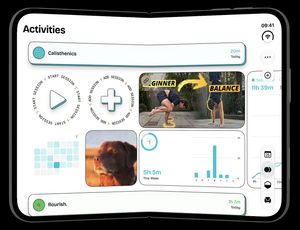
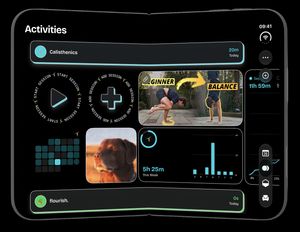
You can use timespent to time your 45-second stretch holds hands-free, track your cumulative weekly mobility volume, and keep your favorite follow-along splits videos right inside your log.
Create a Timed Activity for your splits routine and turn on the built-in Interval Timer—for example, setting 45-second stretch holds with 15-second transition rests—so audio chimes tell you when to switch from your left lunge to your right half-split without reaching for your phone mid-stretch. Set a weekly Do More goal (such as 60 to 90 minutes per week across five sessions) to make sure you consistently hit the 5- to 10-minute clinical volume per muscle group, and add a Link widget on your Activity page to pin a follow-along session like Tom Merrick's front or middle splits routine right next to your calendar heat map and trend charts.
Common questions
How long will it take at 10 to 20 minutes a day?
Practicing 12 to 20 minutes a day five to six days a week puts each muscle group right inside the 5- to 10-minute weekly volume window that unlocks the splits fastest:
| Schedule | Time / muscle | 4-inch gap | 8-inch gap |
|---|---|---|---|
| 10 min, 3 days/wk | ~3 min / wk | 4–6 months | 10–16 months |
| 12 min, 5 days/wk | ~6 min / wk | 2–3 months | 6–9 months |
| 20 min, 6 days/wk | ~10 min / wk | 6–10 weeks | 4–7 months |
When you hold two 45-second sets per muscle group (90 seconds per session) across five days a week, 1.5 minutes × 5 days = 7.5 minutes of direct time under tension per muscle group each week. Because connective tissue responds to frequent signaling, five 12-minute sessions spread across the week close your split gap roughly twice as fast as a single 60-minute stretching session once a week.
Should you stretch for the splits every day?
You can perform gentle 30- to 45-second static holds 5 to 6 days a week, but intense PNF contract-relax sessions or loaded end-range splits need at least 48 hours of recovery between workouts. Moderate passive stretching places very little mechanical damage on muscle fibers, so your nervous system recovers overnight. By contrast, contracting your hamstrings or inner thighs hard at end range creates microscopic tissue fatigue similar to strength training; scheduling intense PNF sessions two to three times a week and light static mobility on the days in between prevents persistent soreness.
Why do my hips pinch on the outside during middle splits?
A sharp pinch or hard block on the outside of your hips during a middle split means the bony knob at the top of your thigh bone (the greater trochanter of the femur) is jamming into the outer rim of your hip socket. As both Dani Winks and Daniel Vadnal in his FitnessFAQs side-splits breakdown explain, trying to sink straight down with an upright torso and a tucked pelvis forces the femur directly into the bone. To clear the hip socket, tilt your pelvis slightly forward (anterior pelvic tilt, sticking your tailbone back slightly and hinging your chest forward onto your hands) or externally rotate your legs so your kneecaps and toes point toward the ceiling.
Can you still learn the splits at 30, 40, or 50?
Almost any healthy adult can achieve flat front splits in their 30s, 40s, or 50s, and most can reach a flat or near-flat middle split once they adjust their pelvic tilt to match their hip sockets. While collagen turnover slows down slightly as you get older—meaning an adult with desk-stiffened hips may need 6 to 12 months where a teenager needs 3 months—adult muscles and tendons still add sarcomeres and remodel reliably in response to 5 to 10 minutes of weekly stretching volume.